Transit to Trails
A roundup of trips reaching nature without a car, from Wisconsin to California
We end up having some version of this conversation on almost every trip. We’re sitting in some station somewhere, watching the departure board flip from “On Time” to “Delayed,” killing an hour we didn’t plan on killing, and someone always eventually says some version of: wow, look at how far we regressed since the 1960s in terms of passenger rail. You could get anywhere in the East and Midwest by train back then. Just picture how much time has been collectively wasted by everyone driving individually all over the country since.
We’ve said some version of that so many times now that we finally decided to actually sit down and dig into the real history, instead of just being mad about it on the platform.
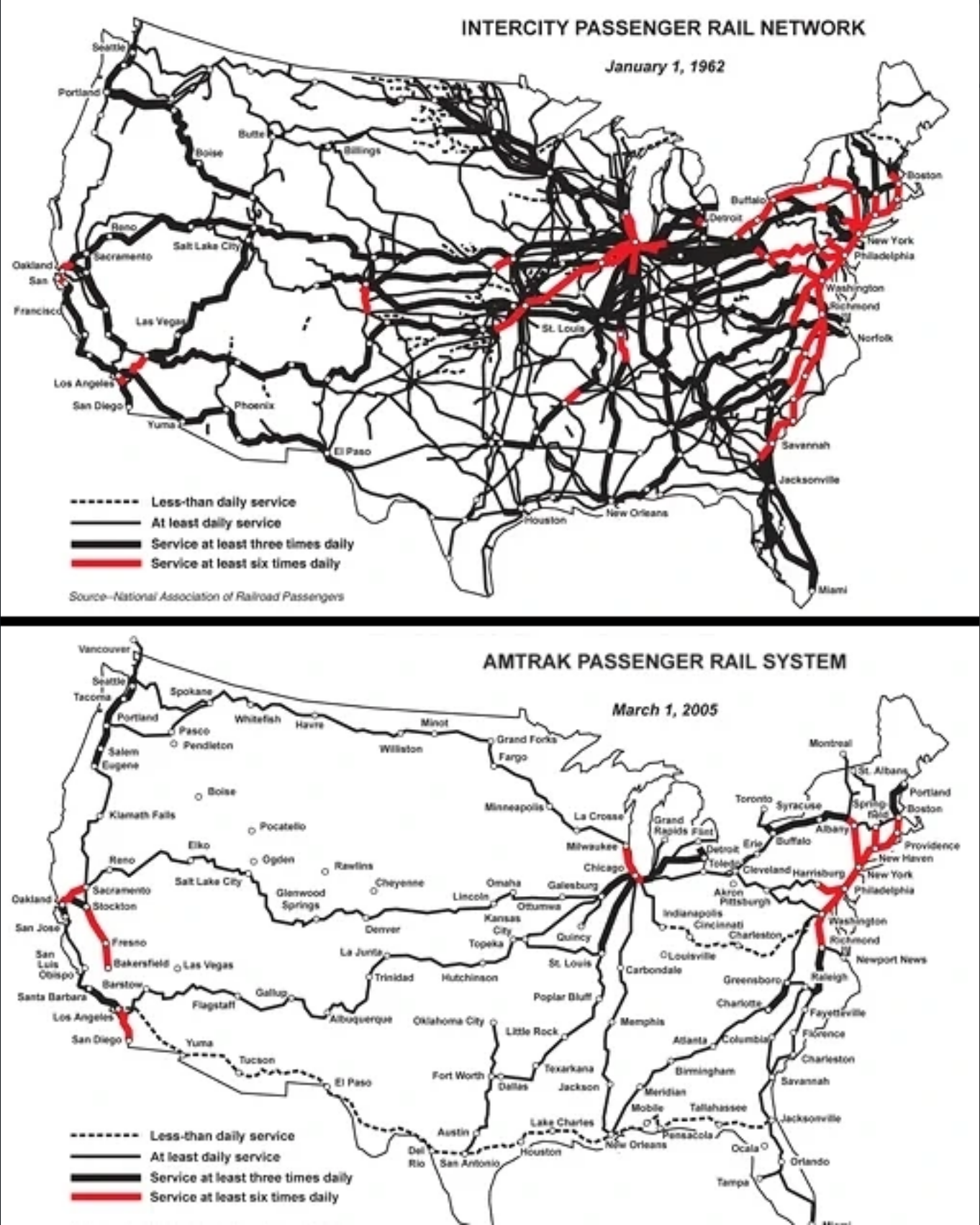
By the 1920s, American passenger railroads were carrying over a billion riders a year, and you really could get almost anywhere by train. There was a whole dense web of branch lines and local runs connecting small towns to regional hubs, the kind of network that just does not exist anywhere in this country anymore. The decline didn’t happen because people suddenly stopped wanting trains. It happened because of a series of policy choices, mostly made after World War II, that tilted the playing field hard toward cars, and it happened slowly enough that most people alive today never got to see what came before it.
The big one is the Interstate Highway System. Eisenhower’s 41,000-mile freeway network, started in the 1950s, was framed as a Cold War defense project, something about being able to move tanks and troops across the country quickly if the Soviets ever invaded. But car manufacturers had been lobbying for free public roads since the earliest days of the automobile, decades before anyone was worried about Soviet tanks. Once that highway network existed, built and maintained almost entirely with public money, driving got dramatically cheaper and more convenient than it had any natural right to be. Railroads, meanwhile, had to build and maintain their own tracks privately, buying up their own land, laying their own rail, paying their own property taxes on all of it, with basically no public investment after the war. When one mode of transportation gets a free public backbone and the other has to build and pay for its own from scratch, that’s not really a fair fight, no matter how efficient the losing side happens to be.
There’s a second, less talked about piece too. Private railroads found freight a lot more profitable than passengers, so a lot of them responded to competition from subsidized trucks and airlines by just quietly letting passenger service get worse: fewer routes, less advertising, higher fares, dirtier cars, rather than investing to actually compete. It was a slow bleed rather than a dramatic collapse, the kind of decline that’s easy to not notice year over year until you look back and the whole network is gone. By the late 1960s the Penn Central Railroad, once one of the most powerful corporations in the country, was headed toward what was at the time the largest bankruptcy in U.S. history. That’s the crisis that led Congress to create Amtrak in 1971, mostly just to keep what was left of the network from disappearing entirely, cobbled together out of the passenger routes the freight railroads didn’t want anymore.
Here’s the part that actually surprised us doing this research: by some federal accounting, passenger rail today is the most heavily subsidized mode of transportation per passenger-mile, more than highways or aviation. That’s a real number, and if you stop there it sounds like a pretty damning case against Amtrak. We wanted to be honest about that instead of pretending it isn’t true.
But we’d argue it tells you less than it seems to. Highway spending is subsidized too, federal gas tax revenue hasn’t covered the full cost of the system in years, it’s just spread across so many more passenger-miles that the per-mile number looks smaller. Highways got seventy years of interstate-scale investment to build up the ridership that makes that per-mile math look good, while passenger rail spent those same decades shrinking, losing routes, losing riders, losing the frequency that makes a train useful in the first place. Comparing subsidies between a mature, built-out system that’s had generations to mature and a network that’s been actively starved for half a century isn’t really apples to apples either way. It’s a bit like judging a plant’s health after you’ve spent decades starving it of water and sunlight, then acting surprised that it needs more resources per leaf than the tree next to it that got watered the whole time.
A train is about as close to the solarpunk ideal of transportation as it gets, and this is really the part that keeps us coming back to it even when it’s inconvenient. A single track can move way more people using way less energy per person than a highway full of individual cars, each one hauling around a couple thousand pounds of steel to move one or two humans. And unlike a highway, a rail line can actually be electrified end to end and run on whatever the grid happens to be doing that day, solar, wind, hydro, whatever the mix looks like locally. You’re not waiting around for battery chemistry or hydrogen infrastructure to catch up to the promise. The tech already exists, has existed for a century in some form, and mostly just needs the political will and public investment to actually build it out.
There’s also just the shape of the experience, which we think matters more than people give it credit for. Driving is fundamentally a solitary activity, everyone sealed into their own box, competing for the same lanes, watching each other as obstacles instead of people. A train car is shared space by design. You can get up, walk to the dining car, strike up a conversation with a stranger, watch the country roll by out the window without having to keep your eyes locked on the road the whole time. It’s a mode of travel that assumes, structurally, that you’re part of a community moving through the world together, instead of an isolated unit optimizing your own private commute. That’s not a small thing. It shapes how you think about the places you pass through and the people you meet along the way.
None of this is really about relitigating 1956, or getting nostalgic for a version of America none of us actually lived in. It’s more that the world we travel in, where driving feels like the normal unsubsidized default and taking a train feels like an inconvenient extra, was built that way on purpose, by specific policy choices made by specific people with specific interests. It didn’t have to go that way, and in theory it could still be built differently going forward. Transportation is one of the biggest chunks of U.S. greenhouse gas emissions, bigger than the power sector some years, and shifting people and freight back onto rail is one of the highest leverage things a country can actually do about that. It’s not some speculative future technology we’re waiting around for someone in a lab to invent. The rails, the electric motors, the whole basic concept, it’s all just sitting there, mostly unused, waiting for the investment to catch up to what it could be.
So we’ll keep taking the trains where we can get them, slow and imperfect as the network is right now. And we’ll keep pushing for more of them everywhere else, with slightly more historical context now, every single time Amtrak cancels one out from under us.
A roundup of trips reaching nature without a car, from Wisconsin to California
Loving our years in Wisconsin, and why California's policies pulled us back
Want to learn more and make your travel sustainable? Reach out on our social media or send us an email to let us know your story.